
Many companies try to be fair when distributing limited supply between markets.
The logic is simple:
if France forecasted 40% of demand and Italy forecasted 60%, then the supply should be split in the same proportion.
On paper, this looks correct.
It protects markets.
It supports local sales plans.
It avoids the feeling that one market is taking supply from another.
But in real business, there is one problem:
Forecasts are never perfect.
One market may forecast too much and sell less than expected.
Another market may suddenly have stronger demand and need more supply than planned.
If the company has already “locked” the stock for each market, the result can be painful:
one market sits on stock it does not need,
while another market loses sales it could have made.
This is especially dangerous for seasonal products, fashion products, products with sizes and colors, campaign-driven products, or any business where timing matters. At the end of the season, unsold stock is not just an operational inconvenience. It becomes margin loss.
The hidden cost of being too fair
For many years, companies solved the fairness problem by virtually separating stock.
Each market received its own virtual stock bucket. The idea was to guarantee that every market would receive the quantity it forecasted.
This approach feels safe. But it can also make the supply chain rigid.
The company may be “fair” according to the forecast – but unfair to the business result.
Because the real goal is not only to protect allocation.
The real goal is to sell the available goods in the best possible way.
When supply is scarce, every piece of stock should answer two questions:
Who has the right to receive it?
and
Who can actually sell it now?
Most traditional allocation processes answer the first question.
They do not always answer the second one well.
What happens in practice
Imagine two markets.
Both gave their forecasts.
Based on these forecasts, the company ordered supply from the vendor.
But the vendor does not deliver everything at once. The deliveries come in parts. Some are early, some are late, some are partial.
Now orders start coming from the markets.
One market places its sales orders very quickly. Another market places them later.
In many standard processes, the market that creates orders first can consume the earliest available supply – even if another market had a fair share of that supply according to the original plan.
The consequence is predictable.
Markets learn that speed matters more than real demand.
They start rushing to create orders.
Sometimes they even create artificial or premature demand just to reserve stock.
This creates a second problem: the demand picture becomes polluted.
And when demand data is polluted, procurement and production decisions become weaker. The company may buy too much, allocate incorrectly, or lose visibility of what customers really need.
So the original attempt to create fairness can create a new source of inefficiency.
A better principle: fair opportunity, dynamic usage
We believe there is a better way.
Markets should receive a fair opportunity to consume supply according to their forecast or business priority.
But this opportunity should not freeze the stock forever.
If a market has real demand, it should receive its fair share.
If it does not use this opportunity within the agreed logic or timing, the supply should become available for markets that can actually sell it.
This creates a self-balancing process.
The company protects market fairness, but it also keeps goods moving.
In other words:
Supply is not blindly given to the fastest market.
Supply is not permanently blocked for the slowest market.
Supply is distributed dynamically according to both allocation rules and real demand.
What we built
Our solution combines allocation logic with dynamic supply assignment.
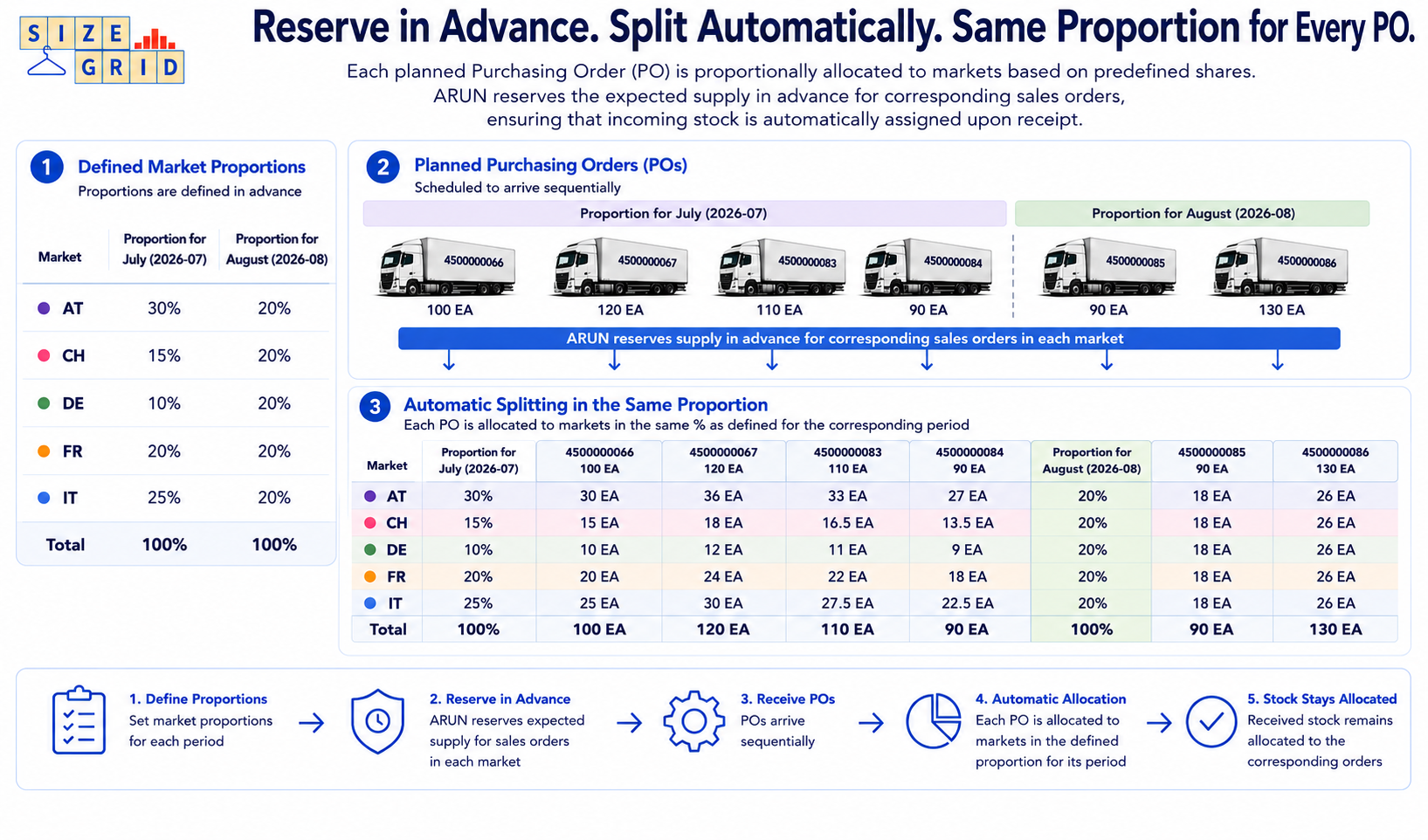
In practical terms, each incoming portion of supply can be distributed between markets according to the confirmed demand and the agreed fair-share logic.
This means that every partial delivery can be assigned in a controlled, proportional, and business-oriented way.
The process does not require the company to redesign the whole supply chain at once. It can be introduced only for selected products, selected product groups, selected markets, or as a pilot.
That is important.
Because many companies do not need a “big transformation project” to start improving allocation. They need a focused business case where the value is visible.
For example:
a seasonal product,
a product with limited supply,
a product with sizes and colors,
a campaign product,
or any product where lost sales and excess stock often exist at the same time.
Why this matters for business leaders
This is not only an SAP topic.
It is a strategy simplification topic.
Many companies have built complex workarounds around the same basic problem:
how to protect fairness without blocking sales.
They create virtual stock separations.
They run manual reallocations.
They process stock transfers.
They negotiate between markets.
They manage exceptions by email and Excel.
They build custom reports to understand who should get what.
All of this complexity exists because the allocation logic is often too static.
A more dynamic process can reduce this complexity.
It can help companies:
protect market fairness,
reduce lost sales,
avoid unnecessary stock freezing,
improve the quality of demand signals,
reduce manual reallocation work,
and make supply decisions more transparent.
The main idea
Fair distribution is important.
But fairness should not mean that stock is locked in the wrong place.
A modern supply allocation process should give every market a fair chance – and still allow the company to react when real demand is different from the forecast.
That is where significant simplification is possible.
Not by adding another layer of complexity, but by replacing static allocation with dynamic, demand-aware distribution.
And the best way to start may be simple:
choose a limited group of products,
run a pilot,
measure lost sales, excess stock, manual effort, and allocation conflicts before and after.
Very often, the business case becomes visible quickly.
Because the problem is not theoretical.
It is already hidden in everyday supply decisions.