
Fair allocation should not become frozen stock
When supply is scarce, market fairness and sell-through must work together. SizeGrid protects market shares while allowing unused reservations to be reassigned to markets with real demand.

Custom process built on SAP aATP foundations
Based on standard SAP aATP elements, SizeGrid developed a custom process for fair supply distribution between markets. Market quotas are defined in PAL and can reflect forecasts, commercial priorities, or agreed fair-share rules. Sales orders consume these quotas through normal confirmation logic.
Our enhanced ARUN process then assigns each relevant supply element proportionally to confirmed demand. If a market does not consume its quota, unused reservation can be redistributed to markets with real demand. Near-term confirmations stay stable inside the freeze horizon, so execution is protected while future supply remains flexible.
The result is fair market allocation without virtual stock separation, new storage locations, or a full logistics rebuild.
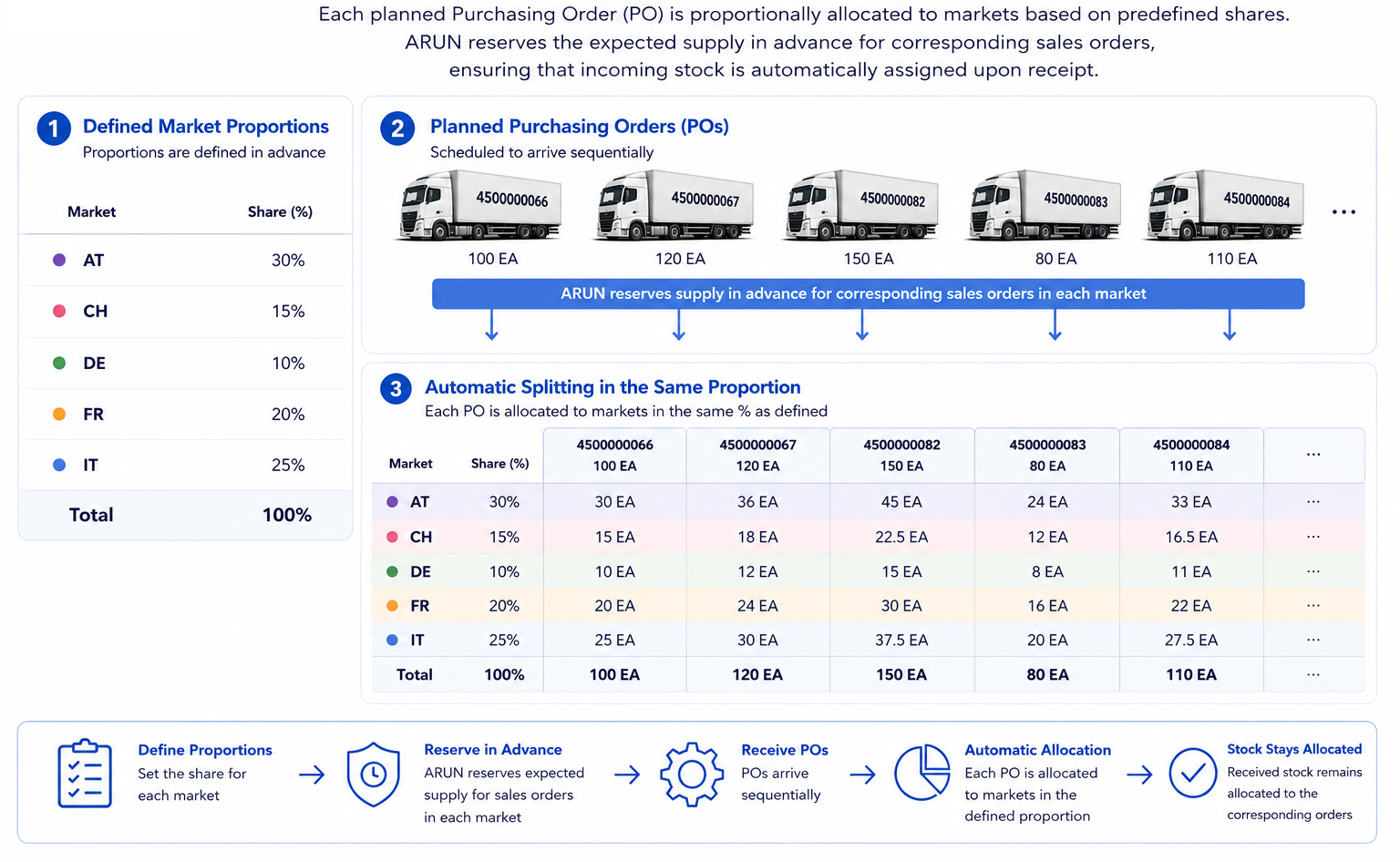
Fair opportunity, dynamic usage, stable execution.
The process gives each market a fair chance to consume its share while keeping stock commercially usable when real demand differs from forecast.
Fair rules, visible quotas, and local market priorities without cross-market distortion.
How the solution works
PAL controls the market quotas. SizeGrid ARUN converts confirmed demand into proportional assignment of each supply element. Nightly redistribution keeps unused supply moving until the freeze horizon.
Define quotas with PAL
PAL objects define the market quotas. The keys can reflect market, product hierarchy, season, color, or another business level.
- Quotas can follow market forecasts
- Priorities can be adjusted quickly
- Different aggregation levels are possible
Confirm orders against quotas
Sales orders consume the PAL quota. When the quota is exhausted, confirmation is reduced or blocked according to the allocation rule.
- Real demand consumes market quota
- Over-consumption becomes visible
- Confirmation discipline starts before assignment
Assign supply proportionally
The SizeGrid ARUN process distributes each supply element between confirmed demand documents in the required proportion.
- Uses only necessary supply
- Handles rounding differences
- Skips markets without enough demand
Redistribute nightly
Demand outside the confirmation freeze horizon is reviewed again. Unused reservation can move to markets with stronger demand.
- Example freeze: 2 weeks
- Near-term orders stay stable
- Future demand remains flexible
Supply reservation changes dynamically until the business needs stability.
Before the freeze horizon, unused reservations can move from low-demand markets to markets that can sell. Inside the freeze horizon, short-term execution becomes stable. For example, orders expected to ship in the next two weeks can keep their expected supply.
- Prevents over-protection of low-demand markets.
- Allows scarce supply to flow where it can be sold.
- Protects near-term shipments from late changes.
- Combines fairness with execution confidence.
No virtual stock split needed
Our solution does not require a rebuild of logistics. There is no need to introduce new storage locations. In many cases, stock segmentation is not needed either, because the process does not rely on virtual stock separation.
Pilot first, scale later
- The practical prerequisite is ARUN relevancy of the articles in scope.
- The process can be tested on selected materials first.
- Results can be evaluated and then scaled to other materials.
- It can coexist with default FIFO logic for normal supply.
Where it fits best
Scarce supply
Use the process when supply is limited and markets compete for the same inbound quantities.
Seasonal products
Especially relevant for campaign-driven, fashion-like, size/color, and time-sensitive products.
Central procurement
Useful when procurement is planned centrally but commercial presence must be protected locally.
Frequently asked questions
Is this a replacement for SAP aATP or FIFO?
No. It complements ATP and aATP. You can keep FIFO for normal materials and apply this process only to scarce materials where fair distribution matters.
Do we need new storage locations?
No. A key advantage is that the process avoids virtual stock separation and does not require a new storage-location landscape.
What is the main prerequisite?
The relevant articles need to be ARUN-relevant. This makes it possible to pilot the process on selected materials.
How does the freeze horizon work?
Reservations are dynamic until the agreed stability point. Near-term orders, such as orders expected to ship within two weeks, can keep their supply reservation.
Make fair allocation more dynamic
Protect markets, keep stock sellable, and start with a focused pilot for scarce materials.